

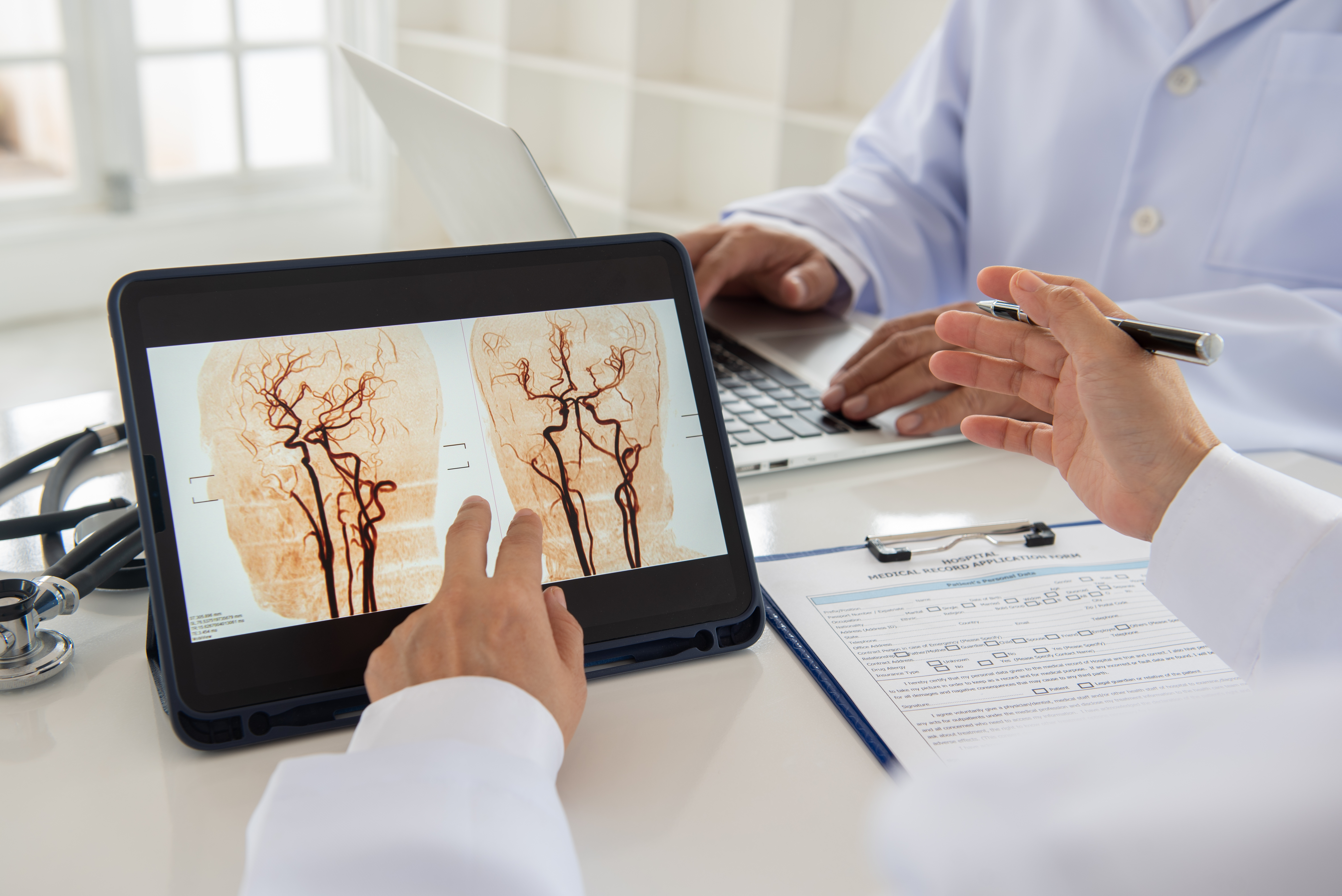
From Hospital Door to Reperfusion: Understanding the Stroke Treatment Pathway
While in previous news articles we have discussed different ways stroke care can be improved, including the use of artificial intelligence (AI) and telemedicine tools, in this article we would like to take a step back and look at the stroke treatment pathway as a whole, reminding our readers of the different stages where valuable time can be lost. With this article, we also invite professionals from around the world working in this field to reflect on their own experiences and share them with us: Where do you see the greatest bottlenecks in your setting? What approaches have helped reduce delays?
From the time the patient enters the hospital until the restoration of blood flow (door-to-reperfusion time), we can identify at least seven components where every minute is important. Below, we explain each of them.
Door-to-imaging
The first priority after hospital arrival is rapid brain imaging. CT and vascular imaging help determine whether the patient has an ischemic stroke, where the blockage is located, and whether they may be eligible for reperfusion treatment. Faster access to imaging means that treatment decisions can begin sooner. Standardized stroke workflow recommendations therefore track door-to-first-image and door-to-vascular imaging times as key performance measures1.
Imaging-to-diagnosis
Imaging is only useful if it leads quickly to a clinical decision. Doctors must interpret the scans, assess the patient’s condition and determine whether intravenous thrombolysis, mechanical thrombectomy, or both are appropriate. In patients with a large vessel occlusion, identifying the blockage quickly is particularly important because thrombectomy may be required2.
Decision-to-transfer
Not every hospital is equipped to perform mechanical thrombectomy. If a patient presents at a primary stroke centre, the team may need to arrange transfer to a comprehensive stroke centre. This drip-and-ship model allows treatment such as intravenous thrombolysis to begin locally while the patient is transferred for thrombectomy. The challenge is ensuring that the transfer decision is made without unnecessary delay2,3.
Preparing for transfer
Once transfer is required, several processes have to happen simultaneously: contacting the receiving centre, sharing imaging, arranging transport and preparing the patient. Even small delays can accumulate. Research suggests that standardized protocols, telemedicine, direct communication between hospitals and remote access to imaging can help reduce door-in-door-out times.3,4
Transport
The journey between hospitals can become one of the largest sources of delay, particularly in regions where thrombectomy centres are far away. Recent evidence shows that longer delays to thrombectomy in drip-and-ship pathways are associated with worse functional outcomes. The question is therefore not simply how quickly an ambulance can travel, but how efficiently the entire transfer network operates3,5.
Arrival-to-angio
After arriving at a comprehensive stroke centre, the patient still needs to reach the angiography suite. Teams may need to reassess the patient, review imaging, prepare equipment and establish access before the procedure begins. Efficient coordination between emergency, neurology, radiology and neurointerventional teams is essential1.
Puncture-to-reperfusion
Finally, mechanical thrombectomy begins with arterial puncture. The intervention then continues until the blocked vessel is reopened and blood flow is restored. Although this final stage may take less time than the preceding journey, it remains critical. Door-to-reperfusion time captures the cumulative effect of everything that happened before and during treatment5.
Taken together, these seven described components illustrate why door-to-reperfusion time should not be viewed as a single number. It represents the cumulative result of multiple interconnected processes, from imaging and clinical decision-making to transfer, transport and thrombectomy. Standardized reporting of these individual intervals can help stroke networks identify where their greatest bottlenecks occur and, importantly, where improvements are possible.
References:
- Goyal M, Saver JL, Ganesh A, et al. Standardized Reporting of Workflow Metrics in Acute Ischemic Stroke Treatment: Why and How? Stroke Vasc Interv Neurol. 2021; 1(1):e000177. https://doi.org/10.1161/SVIN.121.000177
- Palaiodimou L, Papageorgiou NM, Bakola E, et al. Drip and ship in patients with acute ischemic stroke: A narrative review. Ther Adv Neurol Disord. 2025; 18:17562864251378833. https://doi.org/10.1177/17562864251378833
- Ospel JM, Holodinsky JK, Goyal M. Management of Acute Ischemic Stroke Due to Large-Vessel Occlusion: JACC Focus Seminar. J Am Coll Cardiol. 2020; 75(15):1832–1840. https://doi.org/10.1016/j.jacc.2019.10.034
- Boss EG, Bohmann FO, Misselwitz B, et al. Quality assurance data for regional drip-and-ship strategies—gearing up the transfer process. Neurol Res Pract. 2021; 3(1):38. https://doi.org/10.1186/s42466-021-00136-x
- Urbanek C, Jung J, Güney R, et al. Clinical outcome, recanalization success, and time metrics in drip-and-ship vs. drive-the-doctor: A retrospective analysis of the HEI-LU-Stroke registry. Front Neurol. 2023; 14:1142983. https://doi.org/10.3389/fneur.2023.1142983
Author(s): Liva Araka, Rīga Stradiņš University
Keywords: stroke pathway #bottlenecks #door_to_reperfusion #workflow_delays #telemedicine #thrombectomy