

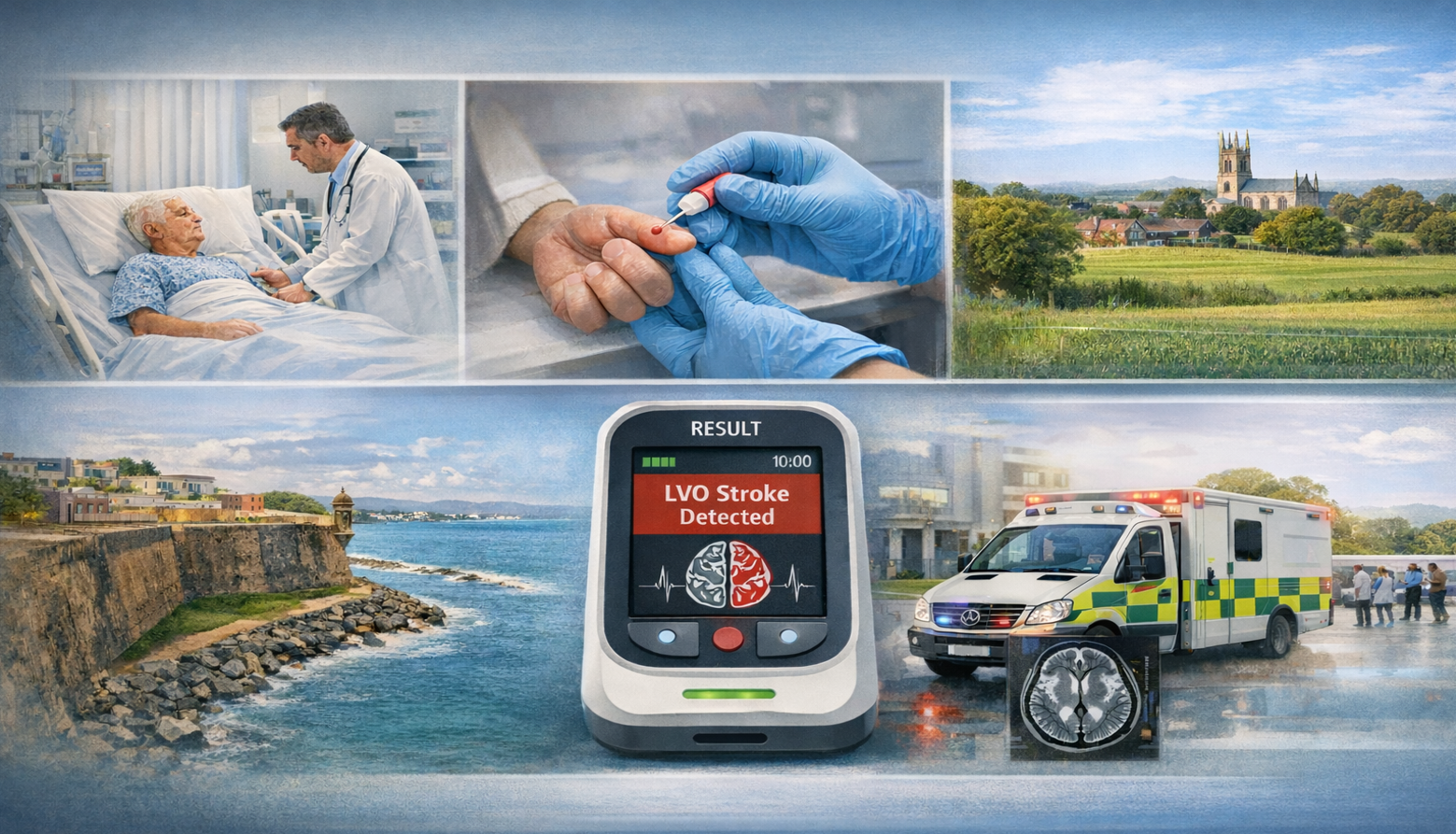
Emergency Care Breakthrough? New Rapid Test Aims to Improve Pre-Hospital Stroke Diagnosis
Large vessel occlusion (LVO) stroke is one of the most serious forms of stroke requiring urgent treatment, and the United Kingdom has initiated new phases of clinical evaluation to complete trials for a rapid differential diagnostic test.
The Rapid Assay Diagnostic for Acute Stroke Recognition (RADAR) study is using LVOne, a rapid (15 min) point-of-care test for use outside the hospital to detect D-dimer and glial fibrillary acidic protein (GFAP) in approximately 500 patients with stroke symptoms.
Also, since June 2025, the LVOne trial is about to begin at the Menonita Hospital in Caguas (Puerto Rico) to evaluate its clinical performance in a different setting with the aim of finding further evidence.
We are awaiting the results to conclude the reliability and specificity of the test along with its use in real clinical settings.
Links:
-Shaw L, Burgess D, Dixit A, et alRapid Assay Diagnostic for Acute Stroke Recognition (RADAR): study protocol for a diagnostic accuracy studyBMJ Open 2024;14:e087130. doi: 10.1136/bmjopen-2024-087130
-Geddes, L. (2025, March 9). Speedy finger-prick tests to diagnose strokes trialled in Cambridgeshire. The Guardian. https://www.theguardian.com/society/2025/mar/09/speedy-finger-prick-tests-to-diagnose-strokes-trialled-in-cambridgeshire?utm_source=chatgpt.com
– Tompsett, P. (2025, June 23). LVOne trial in Puerto Rico. Stroke Foundation. https://www.helenhickstrokefoundation.co.uk/post/lvone-trial-in-puerto-rico
-Walsh, A., & Walsh, A. (2024, January 30). Identifying LVO strokes to increase recovery chances. The Health Innovation Network –. https://thehealthinnovationnetwork.co.uk/archive/identifying-lvo-strokes-to-increase-chances-of-recovery/
Keywords: #RapidStrokeTest #StrokeDiagnosis #PortableDiagnosticTest #LargeVesselOcclusion #LVO
Author(s): David Ramirez Moro, Biomedical Research Institute of Malaga and the Nanomedicine Platform